
Address Matching Software: Validating and Linking Location Data at Scale
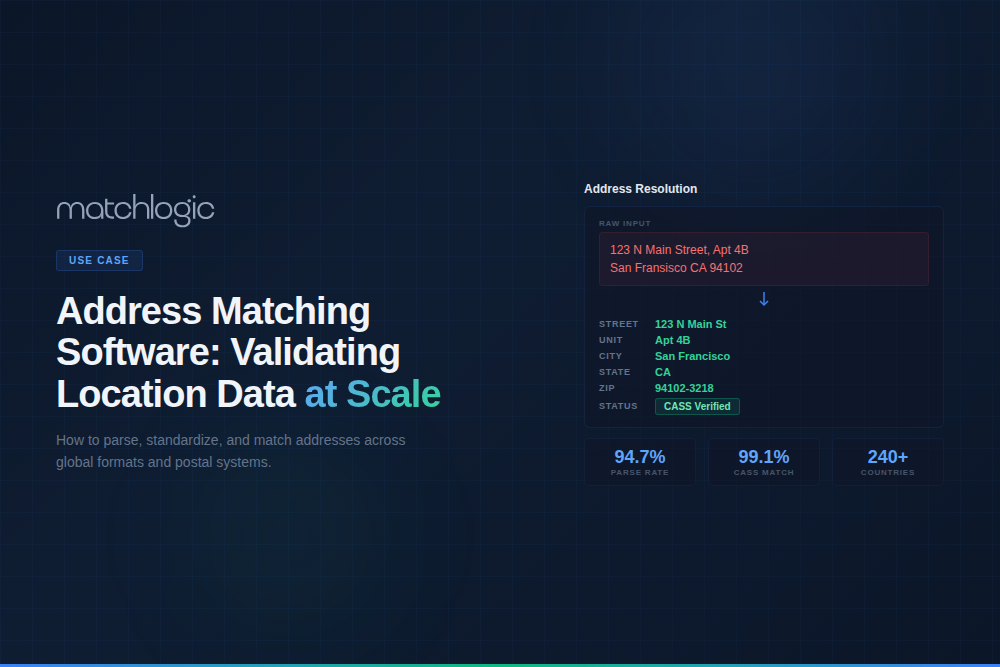
Address matching software identifies when two or more address records refer to the same physical location, even when the records use different formatting, abbreviations, component ordering, or levels of completeness. It combines address parsing (splitting compound address strings into structured components), standardization (normalizing abbreviations, directionals, and suffixes to postal authority conventions), fuzzy comparison (scoring the similarity of standardized components), and optionally validation (confirming the address exists in a postal authority database like the USPS Address Management System). Address matching is a prerequisite for customer deduplication, mailing list merge purge, logistics optimization, and any process where location data has to be accurate and non-redundant.
Address matching is one application of data matching, the broader discipline of identifying when different records refer to the same real-world entity. Address data is the second most variable field type in enterprise systems, behind person names. The same physical location can appear as “123 North Main Street, Suite 400, Springfield, IL 62701” in one system and “123 N. Main St. Ste 400, Springfield, Illinois 62701-1234” in another, and without address matching those become two different locations, creating duplicate customer records, redundant mailings, and skewed analytics.
This guide covers why address matching is distinctly challenging, the three-stage matching process, the role of standardization as a prerequisite, and the enterprise scenarios where it delivers the highest ROI.

Why Is Address Matching Uniquely Challenging?
Addresses are challenging to match because they vary across multiple dimensions simultaneously, and many of those variations are legitimate rather than errors.
How Does Address Matching Software Work?
Effective address matching follows a three-stage process: parse, standardize, then match. The data matching techniques used here, deterministic rules, probabilistic scoring, and fuzzy comparison, are the same ones available for any field type, but they're tuned for the structure of postal records.
Stage 1: Parse Address Components
Before any comparison, address strings have to be parsed into structured components: street number, pre-directional (N, S, E, W), street name, street suffix (St, Ave, Blvd), post-directional, secondary unit type (Apt, Ste, Unit), secondary unit number, city, state, and ZIP code. Parsing handles both single-field addresses (“123 N Main St Ste 400, Springfield IL 62701”) and already-structured records with separate street, city, state, and ZIP fields.
Parsing has to account for ambiguity: is “Springfield” a street name or a city name? Is “400” a secondary unit number or part of the street address? Enterprise parsing engines use positional rules and postal reference databases to resolve those ambiguities. Identifying which records need parsing in the first place is what data profiling tools are for; they reveal where compound fields, missing components, and mixed conventions actually live in your data. Incorrect parsing cascades into incorrect standardization and matching, so parsing accuracy is the foundation of the entire process.
Stage 2: Standardize to Postal Authority Conventions
After parsing, each component is standardized to its canonical form. In the United States, USPS Coding Accuracy Support System (CASS) defines the standard: “Street” becomes “ST,” “North” becomes “N,” “Suite” becomes “STE,” and the address is formatted as “123 N MAIN ST STE 400.” Standardization also covers ZIP+4 code appending (extending the 5-digit ZIP to the full 9-digit routing code) and Delivery Point Validation (DPV), which confirms the address is a real, deliverable location.
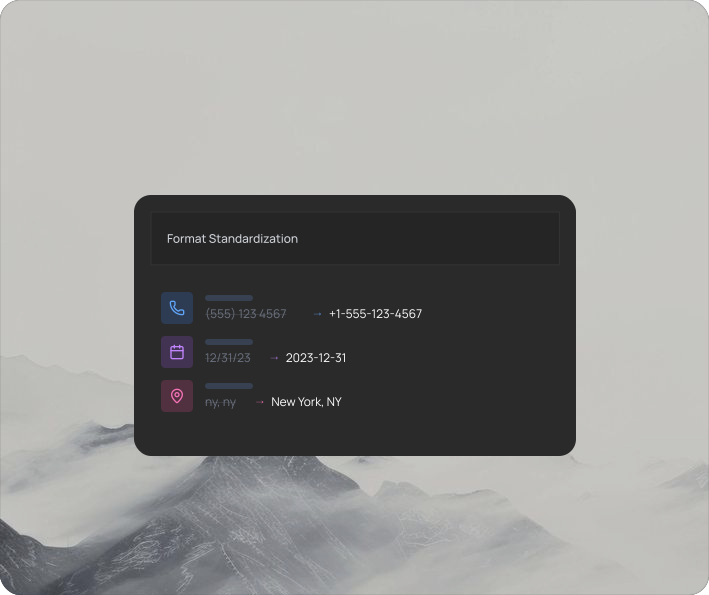
Standardization rules across US, UK, Canadian, and other global address formats are part of the wider discipline of data standardization, and applying them before matching turns most format variants into identical strings, which removes the need for fuzzy comparison on those records.
Stage 3: Match Standardized Addresses
After parsing and standardization, the matching engine compares standardized address components across records. For addresses that standardized to identical strings, the match is exact and the confidence is full. For addresses with remaining differences (typos in street names, transposed digits in house numbers, or missing secondary units), fuzzy matching algorithms score the similarity.
Token-based algorithms (cosine similarity, Jaccard) outperform character-based algorithms (Levenshtein) for address matching because addresses are made of discrete tokens (street number, street name, city) that can appear in different orders. A token-based comparison correctly identifies “123 MAIN ST SPRINGFIELD” and “SPRINGFIELD 123 MAIN ST” as similar, while Levenshtein treats them as highly dissimilar because the character sequences differ. Choosing the right algorithm per field is the whole point of treating fuzzy matching techniques as a toolkit rather than a single method.
Where Does Address Matching Deliver the Highest Enterprise ROI?
Direct Mail and Marketing
Address matching is the foundation of mailing list merge/purge operations. When a retailer combines customer lists from its own CRM, purchased prospect lists, and partner co-registration data, the same household may appear multiple times with slightly different address formats. Without matching, each variant receives its own mailing, wasting print, postage, and brand credibility. According to Experian Data Quality, duplicate addresses inflate direct mail costs by 15–25%. A healthcare nonprofit running merge/purge on its 200,000-record mailing list eliminated 60,000 duplicates and cut direct mail costs by 34% in the first quarter.
E-Commerce Logistics
Incorrect or duplicate shipping addresses cause failed deliveries, re-shipments, and customer dissatisfaction. Address matching at the point of order entry (comparing the entered address against the customer's existing addresses) prevents duplicate shipments to the same household and flags potentially undeliverable addresses before the package ships. The cost of a failed delivery in e-commerce ranges from $5 to $15 per occurrence (return shipping, customer service handling, re-shipment), making pre-shipment address matching a direct cost avoidance measure.
Customer 360 and Entity Resolution
Address is one of the key fields used to link records that refer to the same person across systems. A customer with one address in the CRM and a slightly different format in the billing system can't be unified into a Customer 360 profile without address matching. Combined with fuzzy name matching software and identifier-based comparison, address matching pushes entity resolution confidence sharply higher, which is why database matching software usually weights address among the heaviest fields in its probabilistic scoring model.
Healthcare: Patient Address Linking
Patient records across hospitals, clinics, labs, and pharmacies use different address entry conventions. A patient who moves and updates their address in one system but not others creates address mismatches that complicate record linkage across systems. Address matching that accounts for both current and historical addresses is critical for accurate EMPI (Enterprise Master Patient Index) construction.
Government: Address-Based Program Eligibility
Government agencies use address matching to determine program eligibility (is this address within the service area?), detect benefits fraud (are multiple claims coming from the same address?), and link citizen records across departments. The Census Bureau, IRS, and state benefits agencies all rely on address matching as a core operational capability.
What Should You Look For in Address Matching Software?
Evaluate an address matching tool against the criteria below. The broader fuzzy matching software capabilities still apply; these capabilities sit on top of them and are specific to the structure of postal records.
Parsing Quality: Can the tool parse both compound single-field addresses and already-structured records? Does it handle ambiguous components (is "Springfield" a street or city)? Does it support international address formats?
Standardization Depth: Does it standardize to USPS CASS conventions for US data? Does it support international postal standards (Royal Mail PAF, Canada Post SERP)? Does it include ZIP+4 appending and DPV?
Fuzzy Algorithm Fit: Does it use token-based comparison (cosine, Jaccard) for addresses rather than only character-based (Levenshtein)? Token-based methods handle word reordering and abbreviation differences that character-based methods miss.
Secondary Unit Handling: Does it distinguish between building-level matches ("123 Main St") and unit-level matches ("123 Main St Apt 4B")? Missing secondary units are a major source of false positive address matches.
Integration with Entity Resolution: Can address match scores be combined with name, phone, and identifier match scores into an overall entity resolution probability? Address matching in isolation is less valuable than address matching within a multi-field matching pipeline.
On-Premise Deployment: Address records frequently contain PII (a person's home address). On-premise processing ensures this data never leaves your secured infrastructure. MatchLogic's on-premise architecture handles address matching within your network.
Standardize First, Then Match: The Address Quality Pipeline
Address matching accuracy depends almost entirely on the quality of the parsing and standardization that precedes it. When addresses are parsed into structured components and standardized to postal authority conventions before comparison, most format variants become exact matches, and fuzzy matching is reserved for genuine data quality issues (typos, transposed digits, missing components).
MatchLogic integrates address parsing, standardization, and matching within a single on-premise pipeline. Format transformations, abbreviation normalization, and component extraction happen automatically before the matching engine compares records, ensuring that the fuzzy algorithms focus on real differences rather than formatting noise. For organizations where address data constitutes PII, all processing occurs within your secured infrastructure.
Frequently Asked Questions
What is address matching software?
Address matching software identifies when two or more address records refer to the same physical location, even when they use different formatting, abbreviations, or component ordering. It combines address parsing, standardization (normalizing to postal authority conventions like USPS CASS), and fuzzy comparison to link address records across systems.
What is the difference between address matching and address validation?
Address matching compares two address records to determine if they refer to the same location. Address validation confirms that a single address exists in a postal authority database (like the USPS Address Management System) and is deliverable. Matching finds duplicates across records; validation confirms individual addresses are real. Both are needed for complete address quality.
Why should addresses be standardized before matching?
Standardization converts format variants ("Street" vs. "St.," "North" vs. "N.") into a single canonical form. When standardized, many address pairs that would require fuzzy comparison become exact matches, dramatically increasing matching speed and confidence. MatchLogic benchmarks show standardization improves address matching accuracy by 40–50%.
Which fuzzy algorithms work best for address matching?
Token-based algorithms (cosine similarity, Jaccard) outperform character-based algorithms (Levenshtein) for addresses because addresses contain discrete tokens that can appear in different orders. Cosine similarity correctly identifies "123 MAIN ST SPRINGFIELD" and "SPRINGFIELD 123 MAIN ST" as similar, while Levenshtein treats them as highly dissimilar.
Can address matching software run on-premise?
Yes. Address records are PII (a person's home address). On-premise platforms like MatchLogic process all address matching within your secured infrastructure, with full audit trails. No address data is transmitted to external servers.





.svg)